Taste of Agua Preta From Carmo de Minas
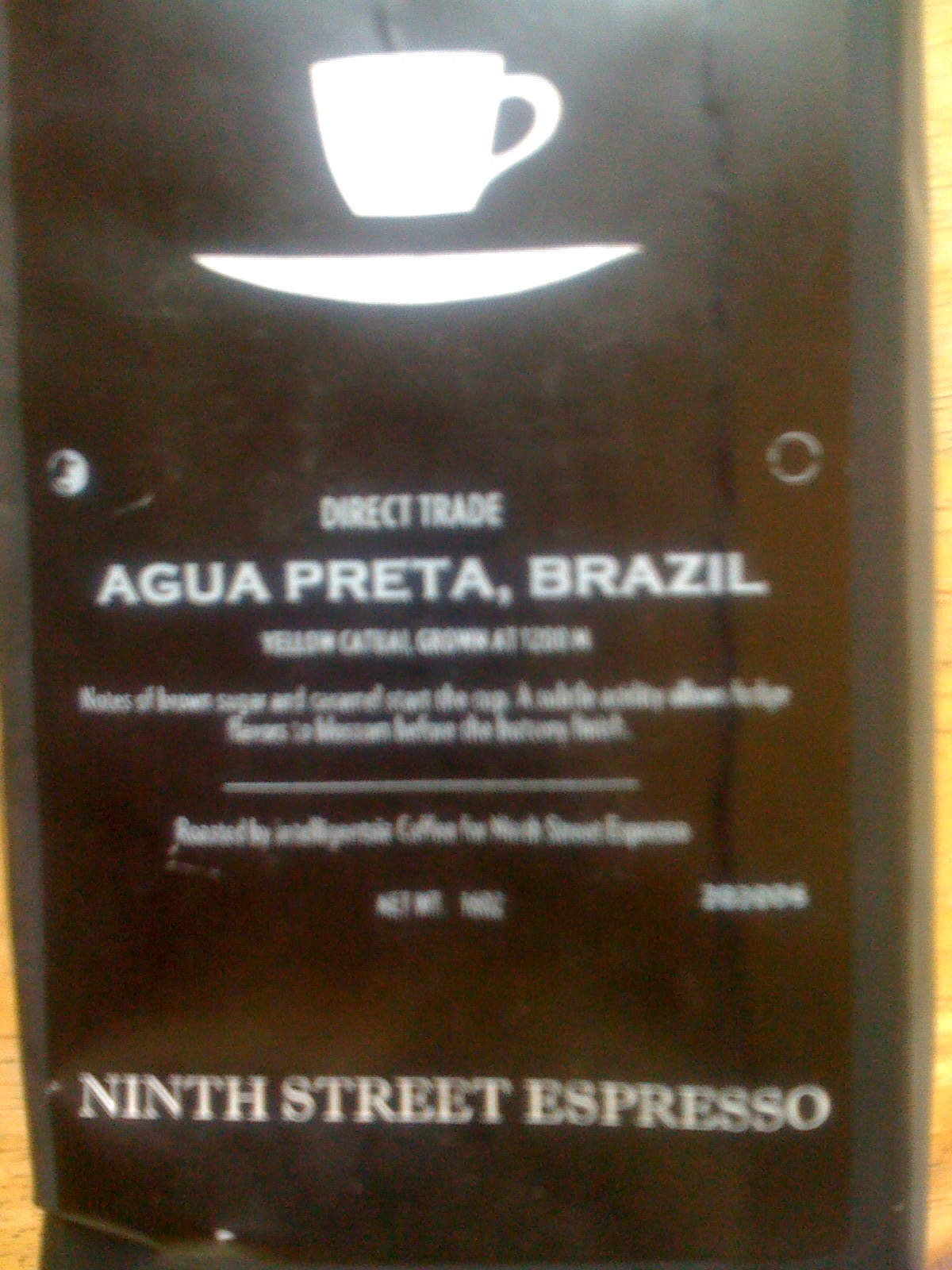
img_0692Earlier this week, my quest for a perfect cup of home-made coffee took me to Chelsea Market, where I picked up this direct-trade coffee from the outpost of Ninth Street Espresso at the market. This was part of my at-home vacation, or staycation, which mostly entailed watching my daughter do gymnastics; taking her to a bookstore, a tea house, and a museum; reading some books; sharing fresh Belgian beer with some friends; working out; updating my Twitter status; and, of course, drinking coffee. Name: Agua Preta, Brazil.

Origin: Produced by Antonio Pereira de Castro and Glaucio Pinto of Fazenda Tijuco Preto in the Carmo de Minas region of Brazil.

Roasted: April 6 or8 by Intelligentsia.

Purchased: April 13 at Ninth Street Espresso, Chelsea Market, 75 Ninth Avenue, between 15th and 16th Streets.

Description: "A silky yet buoyant mouthfeel combines with notes of brown sugar and caramel to create an exquisitely delectable cup. A tamed acidity allows for notes of fudge to blossom right before the buttery finish."

In the cup: I was at first taken aback by what appeared to be a very old roasting date, which I just found in very tiny type on the price tag. But Ken Nye of Ninth Street Espresso has corrected me in the comments, noting that I was probably misreading the tag and that no coffees he sells are older than 12 days. I'm sorry I doubted. The coffee certainly tasted fresh.

This Yellow Catuai was grown at 1200 meters and harvested in August. Here is an excerpt from the tasting notes from Kyle Glanville, director of espresso at the roaster (full PDF is here):

Agua Preta is our first DT Brazilian coffee for filter, and this first lot comes from Fazenda Tijuco Preto, itself a two-time finalist in the Cup of Excellence competitions. Tijuco Preto is blessed with natural springs and a high-altitude plateau that makes harvesting cherries an efficient and easy task. This pulped natural coffee offers striking balance and drinkability with soft acidity, a perfect cup for a lazy morning with the paper.

Well, where to begin. I've been drinking this as espresso for much of the week. This morning I tried it as a regular coffee. Setting aside my ambivalence about the term "mouth feel,' it was definitely silky in both cases. I don't know about buoyant. The acidity is low, though the espressos were slightly more acidic. The hints of chocolate, caramel and fudge were there, more or less, especially in the espresso version, but the finish -- I guess it is buttery -- it is most noticeable in the filter version for some reason. Is "buttery" really the right word? Oh, I suppose. It's a tasty cup of joe.

Men Polishing Their Silver

Several years ago, I was on a suburban commuter train in warmer weather, and I overheard a man who claimed to be a psychiatrist, a big man festooned with silver rings and bracelets, sweating in a suit, talking with an incongruous companion, a tattooed young woman in a skirt. He told her he sometimes worked in a clinic where there were currently 20 men claiming to be Jesus. O.K., I thought, sure, right. Nice round number. I've heard that joke. The man and the woman were just getting acquainted. Perhaps it was a blind date of some sort. He told her how he would never greet patients on the street until they first greeted him, so as not to violate doctor-patient confidentiality.

Read More

Podcast Zeitgeist, Jan. 26

This week's installment is the Podcast Zeitgeist of second chances, and probably the last such post for a good long while. I'll continue to listen to a few favorites, but a hiatus is in order. This started as an effort to make some notes about what worked for me as a listener. But it became an exhausting and time-consuming exercise, particularly since I sampled many more hours than I ever wrote about. It was cutting into my Twittering time. At some point I may summarize what I have learned, or not.[See all lists.]

Read More

A Shot of Cider Currant Spice From Rwanda

img_05681High-end culinary coffee tends to be marketed in specifically political ways. The goal may be to make the customer feel virtuous, or at least more at ease. Maybe buying a particular batch of beans will help the environment or a third-world economy. (There is an ideological divide, even in coffee, between free traders and those who advocate fair or direct trade.) When I hear "Rwanda," I think of the 1990s upheaval and genocide that left that African country in ruins. So I was curious to see this bag of beans and decided to give it a try. Rwanda's coffee industry was nearly destroyed in that era, but now is undergoing a resurgence, thanks to a chain of cooperative farms and efforts to provide simple economic tools, like bicycles. Name: Cider Currant Spice Origin: Nyakizu Cooperative, Byumba Provence, Zirkana, Rwanda Roasted: Jan. 6. Purchased: Jan. 10 at Café Grumpy, 224 W. 20th St., Manhattan, between Seventh and Eighth Avenues. Description: Bourbon, grown at 1500 - 1900 meters above sea level. The Pour: Quite tasty. It is a light and frothy mixture, more spice than cider, I'd say. Perfect for a snowy holiday day in New York. There's no overpowering aftertaste, and it goes down smoothly. Coffee tasters call it a "bright" cup, and I'm starting to get a sense of what they mean by that. I could drink this all day, and I just might. There was not a lot of information on the bag, although I found references elsewhere to the Nyakizu Cooperative, established in 2006. Here's a reference to the 2007 batch from this same cooperative:

The coffee, an Arabica Bourbon, is grown in rich, volcanic soil at a relatively high altitude and holds onto it’s milk chocolaty tones even when roasted a bit dark. Each cup I’ve pulled has given me god-like shots, heady with crema. Other reviews I’ve read recommend the bean more for press coffee than espresso, as there is a bit of a sharp edge to the pulled shots. With a touch of velvety steamed milk, I thought the sharpness wasn’t a problem, but others might.

I wasn't picking up on the chocolate or the sharp edge with this roast, and I thought it worked fine as espresso. But here was another review:

When I first tried this coffee the blackcurrant rushing through with a light and gentle acidity. Underneath there is a hint of floral with a thick creamy body with a really clean and sharp aftertaste. I personally love these coffees in the filter and french press, a wonderfully complex coffee.

I'll have to try this as a regular filtered mug of coffee. The second link above also includes a lengthy history of how the genocide affected the coffee trade (many of those with specialized knowledge of the industry were killed). Specialty coffee sells for four times as much per kilo as regular old coffee, and with direct trade, the farmers keep more of the profits. I don't mind paying more for a good cup, and the marketing works: I get to feel slightly virtuous about a habit that is -- let's face it -- an indulgence, a luxury.