Whitman's 'Quicksand Years' and Not Knowing
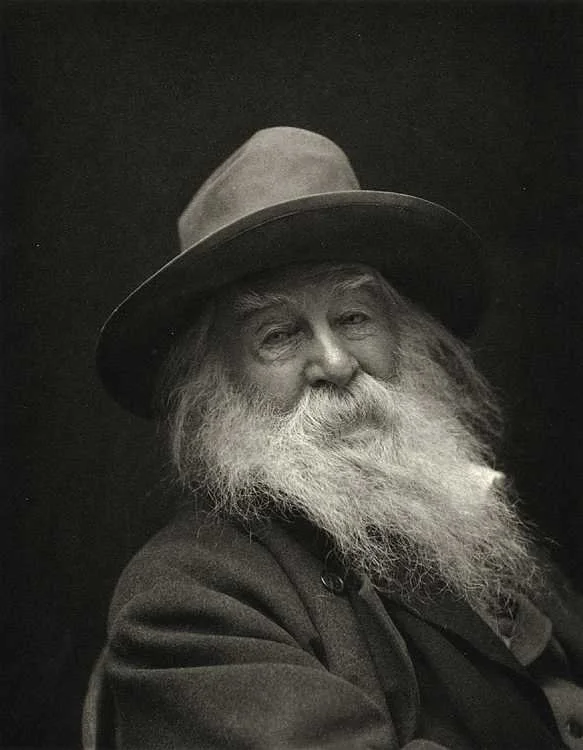
This image was made in 1887 in New York, by photographer George C. Cox
For various reasons, this poem from a later edition of "Leaves of Grass" reminds me of a Zen story that appears in a few different koan collections.
Quicksand Years
Quicksand years that whirl me I know not whither,
Your schemes, politics, fail, lines give way, substances mock and elude me,
Only the theme I sing, the great and strong posses'd soul, eludes not,
One's-self must never give way--that is the final substance--that out of all is sure,
Out of politics, triumphs, battles, life, what at last finally remains?
When shows break up what but One's-Self is sure?
When I was a kid, I used to be afraid that quicksand was around the next corner, thanks to cartoons and old movies.
Yet I have never encountered it.
In recent years, this observation about quicksand as an entertainment trope of 20th century childhoods has become an internet meme and perennial Reddit topic.
Daniel Engber wrote an amusing essay about the topic for Slate in 2010. “Quicksand once offered filmmakers a simple recipe for excitement,” he wrote. “A pool of water, thickened with oatmeal, sprinkled over the top with wine corks. It was, in its purest form, a plot device unburdened by character, motivation, or story: My god, we're sinking! Will we escape this life-threatening situation before time runs out? Those who weren't rescued simply vanished from the script: It's too late—he's gone.”
The Whitman phrase applied to one’s life — “Quicksand years that whirl me I know not whither” — is a bit deeper than a movie trope. The koan it calls to mind appears in koan it calls to mind appears as case 20 in the Shoyoroku collection (often translated as “The Book of Equanimity”). It is also found in “The True Dharma Eye – Zen Master Dogen’s 300 Koans.”
The Zen master Dizang (or Dongshang) is conversing with a traveling monk, Fayan, who stops over in his monastary after being caught in a rainstorm. Dizang asks Fayan where he was headed before the storm. But as with many things a zen master asks, this was not the simple question it seemed.
Fayan said he was on on a pilgrimage.
What was the purpose of the pilgrimage? The master asked.
Fayan replied, “I don’t know.”
Dizang said, “Ah! Not knowing is most intimate.”
We are told that Fayan then had a great realization, presumably some kind of enlightenment experience.
In a commentary on this koan, the late Roshi John Daido Loori wrote, “Going to the words and ideas, we inevitably end up tangled in a forest of brambles.”
Or sinking in a pit of oatmeal, perhaps.
We sometimes think we know what happened, what will happen and what is happening, but in truth not knowing is everything.