Zen Talk: 9/11 and Yunmen's 'Every Day Is a Good Day'
Sunset in Tampa, Fl., Jan. 2, 2020. Copyright Patrick LaForge.
Good evening. It is the fifteenth day of the month in September, the best month of the year in New York. The heat and humidity are fading. The streets are bustling. The bike riding is excellent. People are reuniting after summer travels, making plans, getting back to work. New movies are out, new books, new shows. The zendo has returned to its full schedule.
The date, the 15th, makes me think of case 6 in the Blue Cliff record. Yunmen’s Every Day is a Good Day.
It goes like this. Yunmen said, “I don’t ask you about before the 15th day. Try to say something about after the 15th day.” Yun Men himself answered for everyone. “Every day is a good day.”
Every day is a good day.
That seems simple, but it is not.
It sounds like a bumper sticker. One of those motivational posters that people hang in their office cubicles or college dorms.
Carpe diem. Treasure this day. Live life to the fullest. Stay positive. One day at a time. All worthy sentiments. But, as many commentators note, that is a simplistic misreading of Yunmen’s answer. I have been guilty of this misreading myself.
Yunmen is not telling us to look on the bright side. He is not doing a vibe check.
He is not saying there are no bad days. He is not saying we should always look for the good in the bad. Nor is he saying that all days are of equal weight and value.
It would be tempting here to draw on an intellectual understanding of Zen. Throw around the word emptiness. Maybe Yunmen wanted the monks -- wanted us, because we’re the monks -- to realize that good and bad, days and months, the 15th day, are just concepts, creations of our monkey minds, labels for phenomena that are empty.
That’s true, of course. But I don’t think Yunmen wanted to start a philosophical debate among the monks, either. As far as we can tell from the koan, he didn’t even wait for them to answer. No pause. He just answered it himself.
Every day is a good day. Every day.
A good day for what?
We’ve all had what we call good and bad days. This past Friday was the 25th anniversary of what many agree was a bad day. I listened to a broadcast of the reading of the names at Ground Zero, and the ceremony brought back vivid memories of 2001. Sept. 11 was an important day for me, for my journalism career, and, in the long run, for my Zen practice.
You’ve probably heard people sharing their stories in the past week. I hope you don’t mind hearing one more.
When New Yorkers who were in the city that day talk about it, if they talk about it, they usually start with the weather. It was a brilliant, sunny Tuesday morning, achingly beautiful in the lens of memory. The temperature was 68 degrees and climbing in Central Park, five blocks north of the high-rise where I lived with my wife, Jane, and our 15-month-old daughter, Eva.
It was going to be a good day.
I had been an editor at The Times for four years, and I was scheduled for a night shift on the Metro Desk. It was the day of the mayoral primary. I was going to vote then ride my bike down the Hudson River trail down to lower Manhattan before my shift. I woke up early, around 8:30 a.m. Jane was already up with Eva, playing a game in the other room. NPR was on the radio.
For the past year or two, I had been dabbling with zen, sitting every other month or so with a Zen community, a sangha, that had just moved from Manhattan to Brooklyn. I had bought a zafu and a zabuton, a Buddha statue, incense and a bowl, and set up an altar on an antique wooden table by the bed. It was a reminder to sit.
My practice was more off than on in those days. I wouldn’t even call it a practice. On this morning, I noticed that the altar was dusty, piled with papers and books.
I don’t know why this reminder to sit worked on this morning of all mornings, but it did. I cleared off the altar, lit a stick of incense and I sat.
Later, when I told my 9/11 story, I would often leave out the zen. I’m not sure why. Maybe I didn’t want embarrassing questions or jokes about being woo-woo. New Age stuff. Did I believe in reincarnation? Did Iwant to become enlightened? Was I trying to become a Buddha? A Bodhisattva?
None of that fit my self-image, at age 39, of a skeptical newsman, a no-nonsense journalist, anchored in the gritty real world of metro news.
I could barely keep still on the mat in those days. I had horrible leg cramps. My mind was full of chatter. But on this day, I remember, things clicked. No pain. Calm focus. I was still counting breaths then. I hadn’t come to a deeper experience of breathing. Even so, there was a time when the chattering stopped. Just breathing.
Just breathing.
Then Jane called out from the other room. “Patrick! Wake up!” The radio had said there was a fire at the World Trade Center. I wasn’t too worried. Fires happen all the time in New York. Most don’t even make the news. But I knew I’d have to go to work early. No more meditation, no bike ride. I jumped in the shower. Jane turned on the TV and relayed updates. It looked like a small plane crash. As I was drying off, another shout. The second plane. A commercial jet. Not an accident.
I dressed quickly. I hugged Jane and Eva tightly. I would not see them again until the following morning. It was a tough moment, leaving my family behind, way up in a midtown high-rise, while two of the tallest buildings in the world were burning on the other end of Manhattan.
I was already numbing my emotions. I used to think feelings got in the way of the work. It was a habit I would later come to regret, and try to change.
The story of the attacks, the aftermath and the cleanup would consume my every waking moment for days and nights, weeks, months, years. It would be a long time before I tried zazen at home, a long time before I made it back to a zendo.
It just never seemed like a good day to sit. So many opportunities, lost.
Some events are so traumatic, so shocking, that time itself slows down. The sensory aperture of the mind opens wide like the lens of a camera. Thoughts subside. Every detail is burned into memory.
That was my walk to the newsroom that morning.
Outside our building at 53rd Street and Seventh Avenue, people were milling about, gazing downtown. Others were trudging up from the subway. They said the trains had stopped.
I walked past my polling place, and down Eighth Avenue. Tourists waited for a bus that wasn’t coming, and others waved at cabs that weren’t stopping.
A guy was sitting in his car with the door open, playing the radio loud, reminding me of a clip I had seen from a movie about the day J.F.K. was shot.
An unmarked police car with a siren and light on the dash wailed by.
A man in a business suit slowed in front of me as he recognized a woman he knew. He told her, “I was starting to get shin splints I was walking so fast, but then I decided I wasn’t in a hurry to get to this meeting.”
I sped up. At 48th Street, I walked around firefighters who were suiting up and assembling equipment on the sidewalk in front of their firehouse.
Engine 54 / Ladder 4 / Battalion 9. They sent 15 men downtown that morning. Within an hour they were all dead, when the south tower collapsed.
Every day is a good day.
At 43rd Street, near the newsroom, people were craning their necks and pointing at the sky. I looked up too. Another plane? No. A false alarm. It was the moon, still visible in the daylight in a corner of the sky. I didn’t notice the zen echo until I reread my journal, years later. Fingers pointing at the moon.
A bystander told another guy that he had an inside tip from a friend in the government. He said there were still seven hijacked jets in the air. It turned out there were just two, one headed for the Pentagon, the other flying toward Pennsylvania.
I was one of the first editors to get to the newsroom. A handful of us had a quick meeting and realized the election wasn’t going to happen. We scrambled to reassign reporters and photographers from talking to early voters to covering the unfolding disaster.
A bad day kept getting worse. The Pentagon crash. The collapse of the South Tower, then the north tower. Reports of a plane down in a field in Pennsylvania.
It would take years of reporting and official investigations to tally the precise numbers of casualties, but in the official accounting is 2,983 people died in the attacks and more than 6,000 were injured. It remains the worst terrorist attack in U.S. history.
Every day is a good day.
I spent most of the first day at my desk. I interviewed a Financial District worker who had bolted from her office at the first impact to get her daughter from a day care center at 5 World Trade Center. She saw someone fall or jump from the burning tower. As they caught the last train uptown, she watched in horror as another train pulled in across the platform, letting out commuters who had no idea what was happening above.
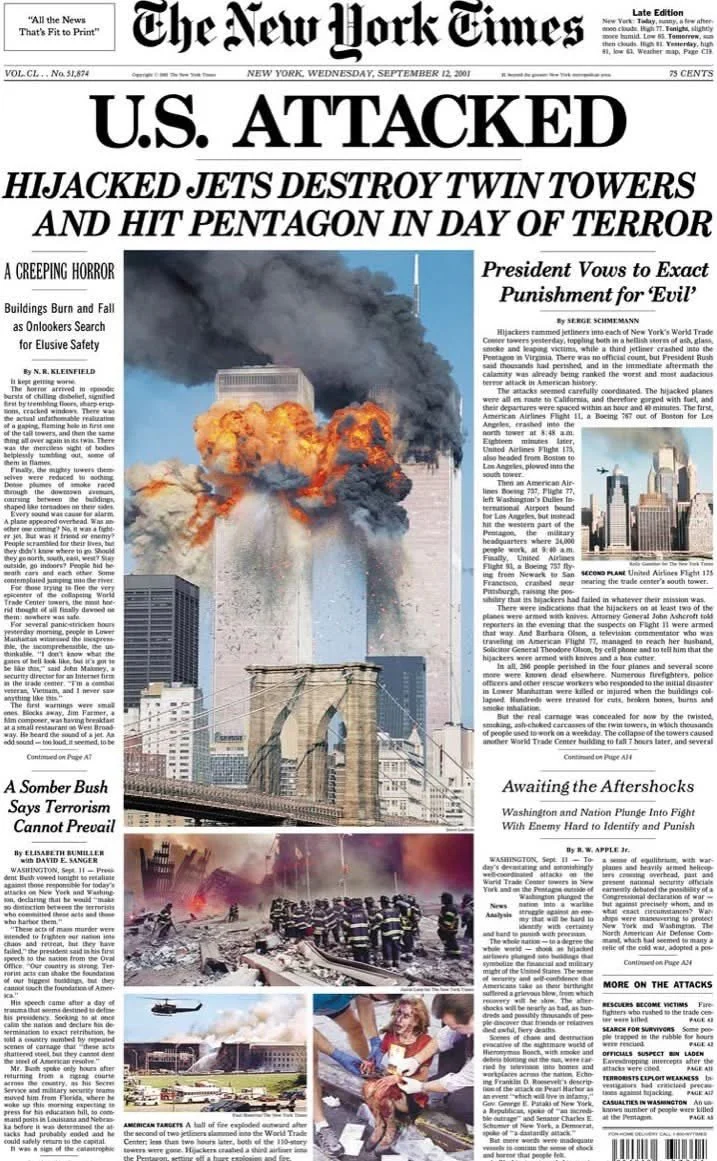
They ignored her shouts. Her account was folded into a front page story the next morning under the headline “U.S. Attacked.”
It is a paradox or an awkward fact that bad days are good for journalism. We don’t wish for death and destruction, but we never feel more useful than when the world is on fire. And as the Buddha tells us, the world is always on fire.
So Sept. 11 was a good day for my career and the careers of many people I worked with. We won Pulitzers. We built bonds that lasted through many stories and roles in the years to come.
We used to tell each other, “This is the biggest story we’ll ever cover,” but we were wrong. The 2008 financial crisis created more economic havoc and misery. If death counts were the measure, then many more people would die in the wars that followed 9/11. Many more would died die in the covid pandemic.
Right after 9/11, the bad days kept coming. A few weeks later, someone started sending anthrax through the mail. White powder scares shut down newsrooms, including at The Times. A plane crashed in the Rockaways in Queens, burning down a neighborhood that was home to already grieving firefighters and their families.
In December a man was arrested on a plane trying to light an explosive in his shoe. And thanks to him we’re still taking off our shoes in airports. A culture of conspiracy theories mushroomed on the internet and never subsided.
This could have been a fertile period for my meditation practice, but I squandered the opportunity.
I found myself turning away from the dharma’s message of acceptance, nonviolence, peace. My city, where I lived with my family, had been attacked. Innocent civilians, including children, had been murdered in cold blood. On many nights I edited the tiny portraits of lives lost, with all their mundane and touching details, the Portraits of Grief, a name I had been credited with inventing. A strange thing to be known for.
That work, the journalism, felt important. But meditation? Sitting on a mat doing nothing? Not so much. For a long time, my primary emotion was anger. It’s not a pretty memory. I didn’t like the Patriot Act, or the drumbeat for war with Iraq, but I had been OK with invading Afghanistan. It made sense to strike back at the ongoing threat of Al Qaeda and the Taliban. I no longer believe that.
The intervening years have taught us a lot about karma. There’s no such thing as surgical warfare. Nearly a million people died directly from war violence arising from 9/11 in Iraq, Afghanistan, Syria, Yemen and Pakistan between from 2001 to 2023, including thousands of U.S. soldiers. Of the dead, more than 432,000 were civilians, noncombatants, including children, who got in the way.
Many more people died "indirectly," because war destroys economies, healthcare, infrastructure and the environment. A study by Brown University a few years ago that included indirect deaths put the toll at nearly 4.7 million people. The true number is unknown.
Four point seven million people.
As I listened to the names of the 9/11 dead being read on Friday, I teared up a little. I felt for the survivors. All that death did not bring back their loved ones, or the years with them that were lost. A few still spoke of vengeance. But others spoke of hope and enjoying life now while you can.
Every day is a good day.
I must admit, it would make a great bumper sticker.
It is good to be alive for another day, even with all the terrible things happening everywhere. Sept. 11 had terror, pain, suffering and grief, but it also had moments of kindness, grace, hope and heroism. And all these events, these variables, are inextricably interconnected, not separate. As a Zen practitioner, I try to respond to events as best I can with as much awareness and skillful means as possible, within the Buddhist moral precepts against doing harm to others. All others.
I did not die on Sept. 11, and neither did you. We were lucky. But someone who did die left a message, a recording that has been heard by millions of visitors to the 9/11 memorial in Lower Manhattan.
His name was Brian Sweeney. He was 38, a former Navy fighter pilot, a passenger on the second plane. He was probably not a Buddhist, and I don’t know if he ever meditated, but he was a Bodhisattva. This is the message he left for his wife, Julie, using an Airphone on the plane.
"Jules, this is Brian. Listen, I'm on an airplane that's been hijacked. If things don't go well, and it's not looking good, I just want you to know I absolutely love you. I want you to do good, go have good times. Same to my parents and everybody, and I just totally love you, and I'll see you when you get there."
It’s a koan about the days after.
I want you to do good, go have good times. Same to my parents – and everybody.
It would be about a decade before I got serious again about zazen. I found my way here to Still Mind Zendo, began sitting regularly with a sangha and working with a teacher on koans. Eventually I got to Case 6 of the Blue Cliff Record.
Yunmen was a zen master in ninth century China during the Tang dynasty. In his time, the 15th of the month was an auspicious day. Chinese monasteries followed a lunar calendar, and that date was the full moon, observed with dharma gatherings and heightened group practice.
It wasn’t a party, from what I gather, but more like extended formal sitting, like the zazenakai retreat we have scheduled for this Saturday.
A good day to sit.
Yunmen said, "I don't ask you about before the fifteenth day. Try to say something about after the fifteenth day."
I imagine the monks were clinging too much to the special day. The anticipation, the experiences on he day itself, the glow after it was over. I’ve felt that way about retreats. Maybe you have too.
Yunmen answered the question himself. “Every day is a good day.”
I don’t think Yunmen is telling the monks how to feel or think about the quality of their days, before or after. The commentaries on the koan make it clear this was an instruction about practice: “He cuts off the thousand distinctions and doesn’t let either ordinary or holy pass.”
Retreats dedicated to contemplation are valuable, wonderful. But most days are not special or unusual. And most days do not bring catastrophes that we remember vividly 25 years later. Most days are undramatic. Just the ordinary annoyances, worries, aches and pains.
I’ve let a lot of ordinary days slip through my hands. So have you, I’m sure.
I can’t do yesterday’s zazen. I can’t do tomorrow’s zazen either. I can only breathe today, right here, right now, with all of you.
Every day is a good day.
I gave a version of this talk on Sept. 15, 2026, at Still Mind Zendo in Manhattan, where I am a senior student and facilitator.