Zen Talk: Light, Darkness and Helen Keller
Within light there is darkness
But do not try to understand that darkness.
Within darkness, there is light
But do not look for that light.
Light and darkness are a pair,
Like the foot before and the foot behind, in walking.
These words are from the Sandokai by the Chinese Zen master Shitou. At our meditation center, Still Mind Zendo in Manhattan, we chant the Sandokai on retreats, and many of us studied it during our recent Ango period. These lines in particular spoke to me, so I wanted to explore them tonight.
Shitou’s pairing of these opposites reminded me of several koans I’ve read over the years. I want to take a closer look at two of them.
The first is Case 28 from the Mumonkan. “Blow out the candle.”
It is one of many koans about Deshan, as he was known in China, also known as Tokusan in Japanese texts. He lived a long life and became a Zen master of remarkable humility and grace in his later years. But as a young man he was arrogant and full of himself.
You can read an entertaining narrative about him in a chapter of “Making Zen Your Own,” by Roshi Janet Abels, from which I have drawn some details here.
I will focus on one part of his story, when Tokusan was a Zen intellectual in his 20s and 30s.
He made his living giving lectures about the Diamond Sutra. He comes off as a know-it-all, a self-righteous zealot who thought other practitioners were doing Zen wrong.
He sounds like the target audience for Shitou’s warning in the Sandokai about pointless division among the schools of zen. For your frame of reference, Shitou died at the end of the eighth century, when Tokusan was a child.
One of Tokusan’s stops as a young monk was at the monastery of the master Longtan, or Ryutan. They ended up talking long into the night. I have a theory about who did most of the talking.
I imagine the master yawning and looking at the candle in his hut burning down to a stub.
All the other monks were asleep. The fires were out. Finally, the tired host suggested that his guest should go to bed. Tokusan made his bows and went to leave but he stopped and said, “It is dark outside.”
So Ryutan handed the candle to Tokusan. But just as the brash young monk was about to take it, the older teacher blew it out. This triggered a deep experience in Tokusan.
Remember that this was about 1,200 years ago. No electric lights. No distant lights from a city glowing in the night sky. Maybe there was no moon, maybe the stars were hidden by clouds. The horror writer Stephen King coined a phrase that I like, for a night like this: Full dark, no stars.
This kind of darkness causes a deep emotional and spiritual response in human beings. It goes back to when we lived in caves. Our minds made up stories about what was out there. But the stories came later. First, the darkness. To be deprived of light is disorienting, especially if it happens suddenly. The rods and cones in our retinas have trouble adjusting. When that candle was blown out, Tokusan was blinded.
In her book, Roshi Janet describes what happened next: his “ego mind that had for so long guided him in his quest for knowledge dropped off; it was metaphorically blown out. He saw clearly that there was no knowledge to gain, nothing to know, and that knowing this was ‘knowing’ everything.”
Quite a teaching. As Roshi pointed out, the teacher used no words, no lectures, no sutra scrolls. There is no meaning, no light, to search for. Just this ordinary life. Just walking, with the foot before and the foot behind. Just sitting. Just breathing.
Within light there is darkness
But do not try to understand that darkness.
Within darkness, there is light
But do not look for that light.
As our teachers pointed out in their words of encouragement during ango, light and darkness seem like opposites but they are in harmony. You can’t have one without the other. Indeed, they are the same.
Here is what my teacher, Sensei Marisa Cespedes, wrote about these lines during Ango study.
“Light and darkness refer to the relative and absolute aspects of reality. The conventional knowable reality (light) seems in opposition with the essential, unknowable, non-dual reality darkness).
But in fact, both aspects contain and generate each other, function together in perfect accord. Without trying to understand the unknowable (darkness), and not looking for the knowable(light), how do we step forward? That’s Shitou’s teaching and perplexing instruction.”
We can read these words and understand them intellectually. Light and darkness are metaphors for the relative and the absolute. Got it! …But reading words do we grasp the great reality? Conceptual understanding is not the same as experience. It’s not the same as having your candle blown out.
It does not help Westerners like us that Zen’s approach can seem counter-intuitive to our cultural stories. The Abrahamic religions – Judaism, Christiniaty, Islam -- use the separation of light and darkness as metaphors for creation and for morality. Light tends to refer to the divine, and darkness is associated with ignorance and evil.
And western philosophers and theologians love the primacy of language. “In the beginning there was the word.” Just like young Tokusan with his scrolls.
Another pillar of western culture is the scientific method. I’m a big fan. The good news for me is that the Buddha told us not to take his word for anything. Investigate. Test for ourselves. Find the facts. I always try to apply scientific method to my practice of dharma.
So what does science say about light and darkness?
You can go down some rabbit holes online in the science and physics forums. I did for this talk. I was a B student in science so please forgive any imprecisions. I am taking some poetic license.
Every once in a while, someone online asks, does total, utter darkness exist anywhere in the universe? Can you search for that darkness and find it?
It’s complicated.
Darkness is a lack of illumination, an absence of light.
But we are human beings, so our understanding tends to get tangled up with human biology. Our eyes are limited to perceiving visible light, the wavelengths that can be seen by the photoreceptors in our retinas. Of course, other creatures, and scientific instruments, can detect wavelengths on the spectrum that human eyes do not. So even if we do not see the light, it is there.
Don’t bother looking for it. Sound familiar?
There’s another wrinkle. For our eyes to see light, the light needs to be reflected. It needs to touch something -- a planet, a moon, a rock, a spacecraft, dust, the eye itself. In other words, light is revealed by forms.
Our eyes are very good at finding visible light. I’ve been trying to improve my sleep with blackout curtains and eye shades. No matter what I do, total darkness is impossible. It is also impossible to create a totally illuminated room without shadows. Objects, including our own bodies, always create shadows.
Some people have posed thought experiments, like putting a person inside a black box in deep space, or deep in a coal mine. An attempt at total darkness.
But every object in the universe produces thermal radiation. So the person and the box would reflect this heat back and forth. And even in a place of near-total darkness, the eye will see spark-like dots, resulting from pressure within the retina. These are known as phosphenes. They are visual creations of the human mind. Imagination? Sensory noise? Who is to say these are not real?
A universe of true utter darkness would have no objects. No forms. Nothing to produce heat or reflect light. No observers.
Does true darkness exist somewhere?
Here is how one anonymous physicist answered that question. "There is such a thing as true darkness, but based on what we observe, it's very likely that this true darkness doesn't exist anywhere in the known universe."
I don’t know if that’s true, but that sure is a koan.
“Known universe” is a great phrase. It’s the ultimate hedge. Hand waving. The rules of physics describe the universe we know, but scientists believe the rules apply even to the parts of the universe we do not know. They would call those the parts we don’t know yet. They’re optimistic. But perhaps there are things we can never know.
If something can’t be measured or described with math and formulas, scientists tend to call that metaphysics. They are not dismissing it. It’s just not relevant to their practical goals.
Their aim to put phenomena like light and darkness in a conceptual framework. The relative world. How everything is related in function and position, as the Sandokai puts it.
But Zen has a simpler instruction when it comes to the absolute, emptiness, not knowing: Do not try to understand that darkness.
That does not mean the darkness of the absolute is beyond experience.
I am reminded of a question that a fellow meditator posed in our group. I will paraphrase. What if someone were blind, deaf and paralyzed with no sense of touch, would that person still experience anything? Would there be a mind, a self?
This is a debate within medicine and philosophy. There is a rare condition known as locked-in syndrome. A medical instrument can measure brain waves in such a case, but there is no way to confirm that the person is experiencing consciousness, except by inference and analogy to our own experience.
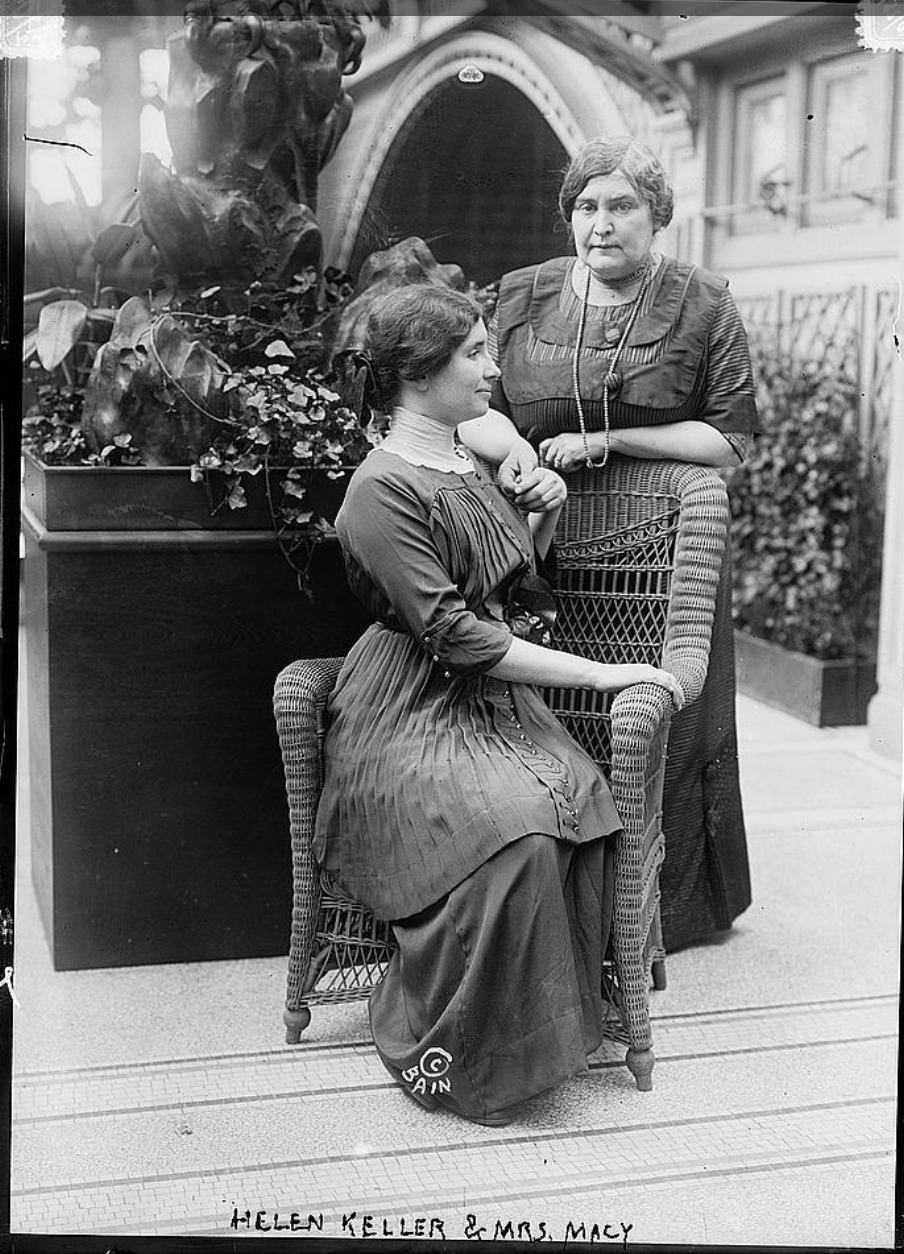
Another case that might help us here, a famous one, is Helen Keller, who became blind and deaf at an early age because of illness. She still had a sense of touch, of her body moving, of taste, but she lived in darkness and silence. She could communicate basic needs with gestures, but she had no sense that words existed, that these movements represented concepts.
As portrayed in “The Miracle Worker,” that insight came at the family well, when her new teacher Annie Sullivan taught her that a sign on the palm of her hand was a word that meant water. It changed Helen Keller’s life.
She went on to write an autobiography and dozens of other books, became a champion of disability rights and helped to found the ACLU, among other accomplishments.
She is known for many optimistic quotes about the human mind and spirit. Here is my favorite:
“I learned that it is possible for us to create light, sound and order within us no matter what calamity befalls us in the outer world.”
Reread that and pause.
I don’t know if Helen Keller ever meditated, or if she knew anything about Zen. But she experienced light, even if she never saw what you and I call light.
That brings me to the second koan I wanted to talk about, Case 86 in the Blue Cliff Record. Yunmen’s radiant light. It goes like this.
As the story goes, the master Yunmen told the assembly: "Everybody has his own light. If he tries to see it, everything is darkness. What is everybody's light?"
And then he answers for them: "The halls and the gate." According to one translation, he then added, "a good thing is not the same as nothing."
The halls and the gate. A good thing is not the same as nothing.
In this koan, light refers to essential nature, our true self. But those are words. I find myself going back to the Sandokai:
Within light there is darkness
But do not try to understand that darkness.
Within darkness, there is light
But do not look for that light.
To see something, there must be a seer and a seen. That sets up an immediate division. But the absolute is one thing, not two. Darkness cannot see darkness. Light cannot see light. That’s like an eye trying to see itself.
Even so, the absolute can be experienced in meditation.
There are Zen words that correspond with that experience, but we don’t need to get into that right now.
If we’re going to use words, let’s use Yunmen’s. He gave his students some good ones.
The halls and the gate. In some translations, he says, the kitchen and the gate.
The commentaries on this koan praise these metaphors but they tend to point to Yunmen’s second phrase as more significant:
A good thing is not the same as nothing.
A good thing, a good phrase, is helpful, but it is still conceptual.
Yunmen is acknowledging that it would have even been better to say nothing at all.
Don’t be like Tokusan, the guy with his sutra scrolls, arguing all night.
Say nothing. Just blow out the candle.
Allow zazen to do zazen – what the Buddha called moment-to-moment attention on breathing.
Zazen doing zazen is our awakening to essential nature, to light and darkness, relative and absolute.
Now, some good news. We are all Helen Keller at the well.
We are alive.
We are breathing.
And the bell has not yet rung.
Pay attention.
I gave a version of this talk on March 17, 2026, at Still Mind Zeno in Manhattan.